The night sky is calling you to look up!
Dark Skies, Eclipses, and Aurora Travel
Why Astrotourism is Booming?
Why Astrotourism is Booming?
Why Astrotourism is Booming?
Astrotourism has exploded from a niche pursuit to a mainstream travel trend. Recent data show that 62% of surveyed travelers plan to visit dark-sky destinations in 2025-2026, making stargazing one of the top travel trends. Tour operators report a 68% year-over-year increase in enrollment for astronomy programs, while the northern lights tourism sector alone generated $834.5 million in 2023.
The timing couldn't be better. We're in a solar maximum cycle that peaked in 2024-2025, creating spectacular aurora displays visible as far south as Florida and the Canary Islands. Two total solar eclipses are coming: August 12, 2026 (Iceland, Greenland, Spain) and August 2, 2027 (Egypt, Morocco, Spain)—with the 2027 eclipse offering up to 6 minutes of totality in Egypt, the longest of this century!
Solar Eclipse 2026
Day(s)
:
Hour(s)
:
Minute(s)
:
Second(s)
Solar Eclipse 2027
Day(s)
:
Hour(s)
:
Minute(s)
:
Second(s)
Understanding Dark-Sky Destinations
What Makes a Dark Sky Place Official?
What Makes a Dark Sky Place Official?
What Makes a Dark Sky Place Official?
DarkSky International has certified over 250 International Dark Sky Places worldwide across 22 countries on 6 continents, protecting more than 196,000 square kilometers of land. The program includes five distinct designation types:
-
-
- International Dark Sky Parks: Protected lands with exceptional night skies and public access. As of early 2025, there are 125 Dark Sky Parks globally, with 88 located in the United States.
- International Dark Sky Reserves: Dark core zones surrounded by populated areas with strict lighting policies, such as Alpes Azur Mercantour in Nice, France.
- International Dark Sky Sanctuaries: The most remote and darkest places with minimal threats to sky quality, like Aotea Great Barrier Island located on New Zealand's North Island.
- International Dark Sky Communities: Cities and towns with comprehensive lighting ordinances. Flagstaff, Arizona became the world's first in 2001.
- Urban Night Sky Places: Dark oases within light-polluted regions, such as Timpanogos Cave National Monument near Salt Lake City.
-
How this Dark Sky Guide is Different
While many well-known dark sky destinations are in cooler climates, this guide highlights warm-weather alternatives perfect for travelers seeking celestial wonders without the cold.
Click the Right/Left side of the image to scroll through the destination guide.
Key Aurora Viewing Facts
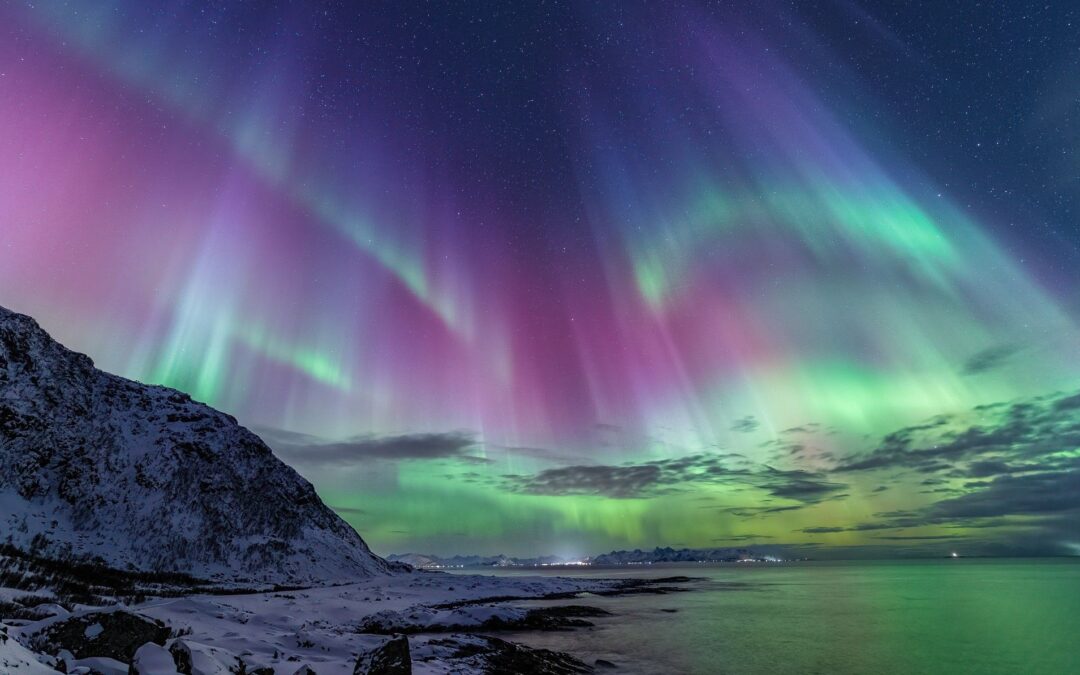
The aurora viewing season runs from September to April in the Northern Hemisphere, with the darkest months (October to February) offering the most consistent nights. March often provides the best combination of darkness and milder temperatures. Current solar maximum conditions (peaking through mid-2026) mean enhanced aurora displays, potentially visible at lower latitudes.
For optimal viewing, plan to stay at least 3-4 nights and be outside between 9 PM and 2 AM when activity typically peaks. Activity often spikes around the equinoxes in September and March.
How and Where to Book
Of course, we suggest you contact us so we can organize your trip from start to finish. However, if you landed on our page and you'd prefer a DIY trip, here are a few companies that may be able to help you.
Current 2026 and 2027 eclipse experiences are already over 75% sold at the time of writing this article, with some luxury cruise departures completely sold out more than a year in advance. Specialized operators like TravelQuest International, Eclipse Travel, and Smithsonian Journeys offer comprehensive packages with expert astronomers onboard.
Remember, we're here to take the planning stress off your plate and find solutions to ensure your astrotourism adventure is fulfilled.
Booking Timeline Recommendations
- Book 12-24 months in advance minimum
- Luxury cruises and all-inclusive packages: 18-24+ months
- Independent travel to eclipse cities: 12-18 months for accommodations
- Last-minute options will be extremely limited and expensive
- Popular destinations (Tromsø, Reykjavik, Fairbanks): 4-6 months advance
- Specialty accommodations (glass igloos): 6-12 months advance
- Winter peak season (December-February): Earlier booking essential
- Shoulder seasons (September-October, March-April): 2-3 months may suffice
- U.S. National Parks (peak summer): 6 months for camping, 3-4 months for nearby hotels
- State parks: 2-3 months typically adequate
- Specialty dark sky lodges: 3-6 months
- Meteor shower peak dates: Book 3-4 months early
Making Your Dark Skies Destination Decision
The perfect astrotourism destination balances several factors:
- Prioritize weather reliability if seeing the celestial event is non-negotiable. Spain for the 2026 eclipse, Alta for northern lights, and established dark sky parks with historical clear-sky data reduce weather risk.
- Consider accessibility against the remoteness you desire. Tromsø and Reykjavik offer easy access and infrastructure but more crowds; Scoresby Sund and Big Bend offer pristine isolation but require significant travel logistics.
- Match accommodation level to your needs. A glass igloo creates unforgettable memories but isn't necessary to see spectacular aurora. Conversely, extremely remote locations may require accepting whatever accommodations exist.
- Factor in the complete experience. The best astrotourism destinations offer compelling activities beyond stargazing—whether that's Iceland's geothermal pools, Egypt's ancient temples, or Alaska's dog sledding.
- Budget realistically. Astrotourism can range from affordable camping trips to ultra-luxury experiences. Determine what level of comfort and expertise you need, then allocate funds accordingly.
- Book early. The surge in demand for astrotourism means popular destinations and dates sell out far in advance. If you're targeting a specific eclipse or peak aurora season, don't delay.